


2 Core Reasons Tesla Investors Should Be Getting Nervous
2 Core Reasons Tesla Investors Should Be Getting Nervous

Daniel Miller, The Motley FoolTue, August 11, 2026 at 9:35 PM UTC
0
Key Points -
As Tesla celebrated its 10 millionth vehicle produced, the company is battling to reverse two consecutive years of annual delivery declines.
Tesla's robotaxi faces challenges in not only regulatory approvals, but catching rivals in true driverless miles.
An aging product lineup combined with intensifying global competition has pressured Tesla's margins.
These 10 stocks could mint the next wave of millionaires ›
&&
Near the end of July, Tesla(NASDAQ: TSLA) achieved something no other automaker has done in history: It produced its 10 millionth full-electric vehicle (EV). It's a huge milestone and feels appropriate for the company that largely drove the global surge in EV investment. With that milestone comes the bittersweet truth that Tesla isn't quite the automaker most long-term investors signed up for.
Tesla's future is clearly driving toward a future of humanoid robots, robotaxis, and Artificial Intelligence (AI). While that could prove wildly lucrative for Tesla down the road, it also adds immense near-term uncertainty as it transitions. For investors considering jumping on board, here are two reasons buying Tesla should make you nervous.
Missed Nvidia in 2009? This Rare Signal Is Flashing Again.In 2009, a "Double Down" signal flashed for a little-known chipmaker called Nvidia. For the first time in years, that same "Total Conviction" signal is flashing for a company 1/100th the size of Nvidia. Continue »
&&
Valuation breakdown
Morgan Stanley's Adam Jonas, a longtime Tesla bull and respected auto analyst, broke down Tesla's valuation and believes that roughly 34% of its total valuation is driven by its core automotive and energy business. In comparison, 41% is driven by the hype surrounding its robotaxi and autonomous driving technology. The last 25% is driven by the potential of its Optimus humanoid robot. Let's hit two of those segments and discuss why there are concerns.
Robotaxi woes
While a big chunk of Tesla's valuation is driven by its robotaxi business, which doesn't really exist yet, the company finds itself trailing competitors in full-driverless miles (no supervisor) and in regulatory approvals. Alphabet's Waymo has logged over 200 million fully autonomous, no-supervisor miles and generates roughly 500,000 weekly paid rides across major metropolitan areas, and Baidu has surpassed 137 million fully driverless miles.
On the flip side, per Tesla's second-quarter earnings report, the automaker has a cumulative 2.4 million paid robotaxi miles, and that growth between the first and second quarter was essentially flat. There's a little smoke and mirrors with Tesla, because it announced plans to launch in new markets such as Tampa and Orlando, as well as across the Austin metro area, but it's estimated that Tesla's active unsupervised driverless fleet remains a modest 20 to 40 vehicles.
Another factor that could make investors nervous is that while Tesla is ramping production of its Cybercab, which will need regulatory approvals before it can charge for rides, it hasn't outlined a clear plan or timeline for the approval process. Meanwhile, Amazon-owned Zoox was just granted permission by the National Highway Traffic Safety Administration (NHTSA) to commercially deploy steering-wheel-free robotaxis at a rate of 2,500 vehicles annually for two years, for a total of 5,000 vehicles. Zoox's robotaxi is the first vehicle designed from the ground up with no manual controls to receive approval and is poised to begin paid rides in Las Vegas.
It's also fair to bring up the potential complications of Tesla's strict camera-only approach to driverless vehicles, rather than including sensors such as LiDAR and radar for better depth perception and adverse-weather mapping. That isn't to say Tesla's strategy isn't possible, but that scaling the Cybercab could be much slower. Further, Tesla faces looming issues with its older Hardware 3 (HW3), which lacks the memory bandwidth and processing power required for true unsupervised Full Self-Driving, as promised to consumers -- the outcome of this is still unfolding.
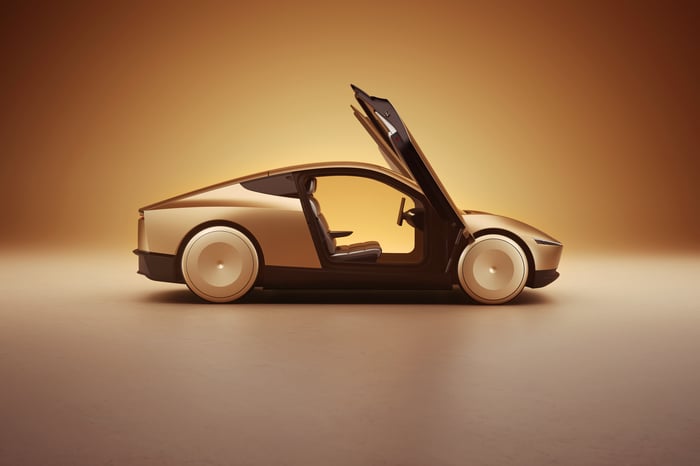
Tesla's Cybercab. Image source: Tesla.
Softening core
Tesla's future might indeed be lucrative with investments in robotaxis, robots, and AI, but right now, its core business is still manufacturing vehicles, and that's slowly eroding. For years, Tesla's guidance was for roughly 50% annual growth in production and deliveries, but that trend stopped when the EV maker peaked in 2023 at 1.81 million deliveries. Then, that figure declined for two consecutive years, with 2026 still up in the air.
Advertisement
Tesla's mass-market Model 3 launched in 2017, and the Model Y in 2020, and neither has received a complete redesign; instead, the company relies on minor trim adjustments, stripped-down versions, and software updates to drive demand. Tesla's Cybertruck was a flop; the Model S and Model X were discontinued to free up factory space for robotics production; and the Tesla Semi is years behind schedule, even though it's making a strong impression with truckers. Because of growing global EV competition and an aging lineup, Tesla's profit margins have been under pressure due to price cuts to drive demand, low-cost financing incentives, and other promotional discounts.
TSLA Operating Margin (TTM) data by YCharts.
Time will tell whether Tesla follows through on the next-generation Roadster or ever launches an all-new low-cost Tesla vehicle, but keep in mind the company has historically overpromised and underdelivered, often later than anticipated.
What it all means
Tesla has achieved some amazing things, and producing its 10 millionth vehicle is a very real accomplishment. But there's much uncertainty hanging over Tesla, including a potential merger with SpaceX. Its product portfolio is aging and pressuring margins, its capital expenditures on future businesses are exploding with little to no return on the horizon, and its robotaxi business is in the rearview mirror of multiple competitors. Tesla could continue to be a phenomenal investment, but there is much risk and uncertainty, and plenty of reasons to be nervous -- research thoroughly before buying!
Don’t miss this second chance at a potentially lucrative opportunity
Ever feel like you missed the boat in buying the most successful stocks? Then you’ll want to hear this.
On rare occasions, our expert team of analysts issues a “Double Down” stock recommendation for companies that they think are about to pop. If you’re worried you’ve already missed your chance to invest, now is the best time to buy before it’s too late. And the numbers speak for themselves:
Nvidia:if you invested $1,000 when we doubled down in 2009,you’d have $564,953!*
Apple: if you invested $1,000 when we doubled down in 2008, you’d have $58,803!*
Netflix: if you invested $1,000 when we doubled down in 2004, you’d have $411,427!*
Right now, we’re issuing “Double Down” alerts for three incredible companies, available when you joinStock Advisor, and there may not be another chance like this anytime soon.
See the 3 stocks »
*Stock Advisor returns as of August 11, 2026.
&&
Daniel Miller has no position in any of the stocks mentioned. The Motley Fool has positions in and recommends Alphabet, Amazon, Baidu, and Tesla. The Motley Fool has a disclosure policy.
Source: “AOL Money”
